
TechVerda
Transforming Ideas Into Reality
- contact@techverda.com
- Innovation One, DIFC, Dubai

Blog Detail
Say Goodbye to AI Amnesia: Observational Memory Slashes Costs and Boosts Agent Performance
Say Goodbye to AI Amnesia: Observational Memory Slashes Costs and Boosts Agent Performance
The world of AI agents is evolving rapidly, moving beyond simple chatbots to sophisticated systems embedded in critical production workflows. However, a persistent challenge has been AI 'memory' – how these agents retain and utilize context over long periods. Traditional methods like Retrieval-Augmented Generation (RAG) are showing their limitations in speed and efficiency for these advanced use cases. Enter Observational Memory, an innovative approach from Mastra that promises to cut AI agent costs by up to 10x and dramatically improve performance on long-context benchmarks.
The Memory Problem in AI Agents
As AI agents become more integral to business operations, their ability to remember past interactions and decisions is no longer a nice-to-have but a fundamental requirement. Imagine an AI assistant helping you manage your content on a website; it needs to recall specific formatting requests you made weeks ago. Or an AI system triaging alerts for engineers – it must remember which issues were investigated and what actions were taken. Current RAG systems, which dynamically retrieve information, often struggle with the speed and the sheer volume of data required for these long-running, tool-heavy agent tasks. This is where Observational Memory steps in, offering a fundamentally different architecture.
Introducing Observational Memory: A New Paradigm
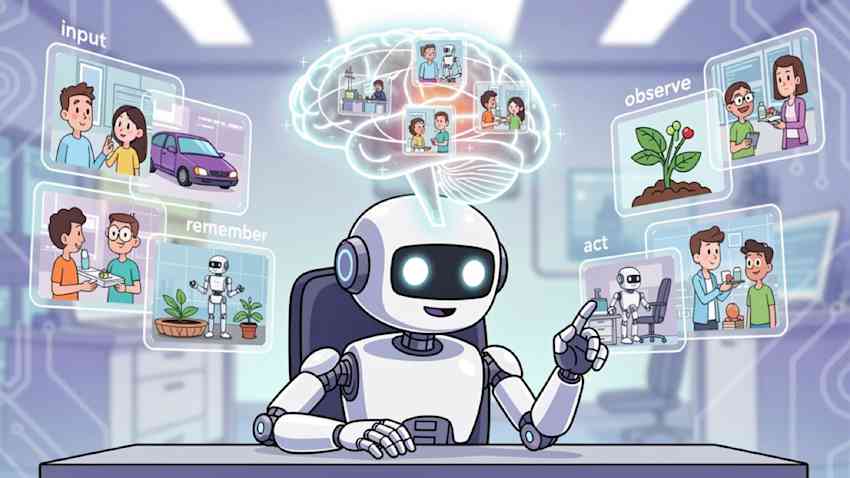
Developed by Mastra, the team behind the popular Gatsby framework, Observational Memory takes a unique approach to AI context management. Instead of constantly retrieving information from external sources, it focuses on compressing and retaining what the agent has already experienced. It achieves this through two background agents: the Observer and the Reflector.
Here's how it works:
- Observer Agent: This agent continuously monitors the conversation history. When a certain threshold of unobserved messages is reached (e.g., 30,000 tokens), the Observer compresses these messages into concise, dated 'observations'. These observations are then added to a dedicated log, and the original raw messages are discarded.
- Reflector Agent: Periodically, when the log of observations grows large (e.g., 40,000 tokens), the Reflector agent steps in. It restructures and further condenses the observations, combining related points and removing redundant information. The key here is that it maintains an event-based log of decisions and actions, rather than a simple summary.
This method offers significant compression ratios, ranging from 3-6x for general text to an impressive 5-40x for tool-heavy agent workloads that generate substantial output. Crucially, it prioritizes recalling what the agent has already processed, making it less suited for open-ended knowledge discovery but highly effective for maintaining consistent, long-term context.
The Economic and Performance Advantages
One of the most compelling benefits of Observational Memory is its impact on costs. AI providers often offer significant discounts (4-10x reduction) for cached prompts. Traditional memory systems, which constantly alter the prompt with dynamic retrieval, can't effectively leverage this caching mechanism. Observational Memory, however, maintains a stable context window. The observation log remains largely consistent, allowing for aggressive caching and drastically reducing token costs. This stability also translates to more predictable budgeting for AI workloads.
The performance gains are equally impressive. On the LongMemEval benchmark, Observational Memory achieved a remarkable 94.87% score with GPT-5-mini. Even with the widely used GPT-4o model, it scored 84.23%, outperforming Mastra's own RAG implementation which scored 80.05%.
Why This is a Game-Changer for Enterprise AI
The implications for enterprise use cases are profound. Applications like in-app chatbots for CMS platforms, AI SRE systems for IT operations, and document processing agents all demand long-term memory. Observational Memory provides this by ensuring that agents can recall context spanning weeks or even months. This is critical for user experience, as forgetting past interactions can be jarring and detrimental to productivity.
Mastra has made Observational Memory available as part of its Mastra 1.0 release and has also provided plugins for popular frameworks like LangChain and Vercel's AI SDK, making it accessible to a wider developer community.
Key Takeaways:
- Cost Reduction: Stable context windows enable aggressive prompt caching, slashing token costs by up to 10x.
- Performance Boost: Observational Memory outperforms RAG on long-context benchmarks.
- Simplified Architecture: It's text-based and doesn't require specialized vector or graph databases, making it easier to manage.
- Enterprise Ready: Ideal for long-running agent conversations crucial for production systems.
- Focus on Retention: Prioritizes remembering past agent decisions and actions over broad external searches.
As AI agents move from experimental stages to becoming integral parts of production systems, the way we handle their memory will be as important as the models they use. Observational Memory offers a compelling and cost-effective solution for ensuring AI agents remember what matters most.
Can You find Now