
TechVerda
Transforming Ideas Into Reality
- contact@techverda.com
- Innovation One, DIFC, Dubai

Blog Detail
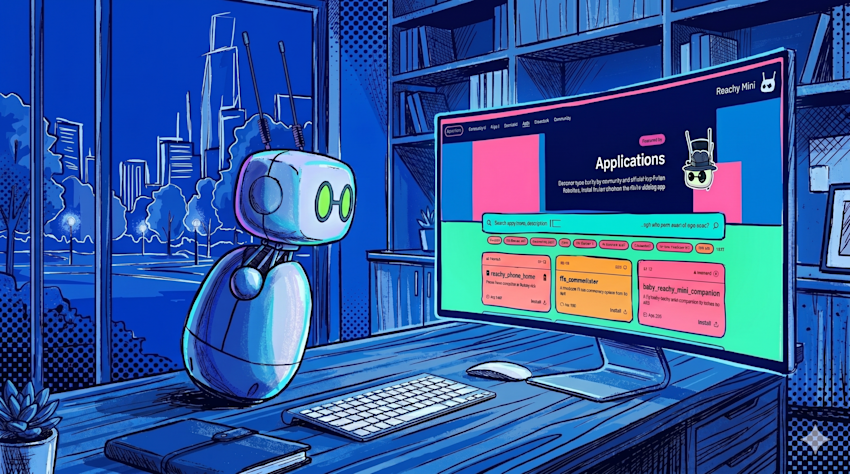
Robots Get Their Own App Store: Hugging Face Unleashes 200+ Apps for the Reachy Mini
Robots Get Their Own App Store: Hugging Face Unleashes 200+ Apps for the Reachy Mini
For years, the app store has been synonymous with our smartphones, bringing a universe of functionality to our fingertips. Now, imagine that same convenience and accessibility applied to the world of robotics. That future is here, thanks to Hugging Face, a leader in open-source AI, which has just launched the Reachy Mini App Store. This groundbreaking initiative hosts over 200 community-built applications, signaling a major leap in making robotics accessible to everyone.
The Dawn of the Robot App Store
Hugging Face, already renowned for its extensive collection of AI models and applications, has expanded its ecosystem to include physical robots. The newly launched Reachy Mini App Store is designed for their Reachy Mini, an affordable ($299) open-source desktop robot that debuted in July 2025. This move effectively removes the significant technical barrier that has historically kept robotics development confined to experts.
The significance of this launch cannot be overstated. It means that individuals without extensive engineering or coding backgrounds can now easily download and implement functional robotics software in mere minutes. As Hugging Face CEO Clément Delangue puts it, "Anyone can build the apps." This democratizes robotics, opening doors for AI model builders to test their creations in a physical, interactive environment.
Breaking Down the Robotics Barrier
Traditionally, the complexity of robotics software has stemmed from the scarcity of high-quality training data specific to hardware interactions. While Large Language Models (LLMs) have thrived on vast code repositories like GitHub, robotics code has been comparatively limited. This has made it challenging for AI agents to grasp the nuances of physical hardware and firmware.
Hugging Face’s innovative solution is an agentic toolkit that acts as a seamless intermediary. Users can now describe desired robot behaviors in plain English – for example, "wave when someone says good morning" – and an AI agent handles the complex tasks of writing, testing, and deploying the code. This process bypasses the need for users to learn specialized robotics SDKs or delve into intricate firmware details, collapsing what used to be weeks of integration work into a matter of minutes.
The platform's flexibility is a key feature, supporting a wide array of AI models, including Hugging Face’s own ML Intern, as well as powerful external models like GPT-5.5 and Claude Opus 4.6. Real-time interactions are powered by advanced solutions like OpenAI Realtime and Gemini Live, ensuring a smooth and responsive user experience.
Reachy Mini: An Affordable Robotics Platform
The Reachy Mini itself is a testament to Hugging Face’s commitment to accessibility. Launched as an open-source alternative to expensive commercial robots (think Boston Dynamics’ Spot at $70,000 or Chinese competitors starting at $1,900+), the Reachy Mini is priced for hobbyists and developers alike:
- Reachy Mini Lite ($299 + shipping): A tethered version requiring an external computer for processing.
- Reachy Mini Wireless ($449 + shipping): A standalone unit with an integrated Raspberry Pi CM 4 and Wi-Fi.
The response to Reachy Mini has been phenomenal, with sales surging to 3,000 units in just the past two weeks, adding to the 10,000 already sold since its launch in July 2025. Remarkably, even those who don't own a Reachy Mini can still develop and test applications using the Reachy App’s 3D simulator, ensuring that innovation isn't limited by hardware availability.
The Power of Open Source and Community
The Reachy Mini App Store, hosted on the Hugging Face Hub, functions much like a familiar software repository but is tailored for hardware behaviors. Key features include:
- Search and Install: Easily find and deploy apps directly to your robot.
- Forkability: Duplicate and modify existing apps using AI, fostering rapid customization.
- Simulation Mode: Build and test applications in a browser-based virtual environment.
This approach is part of Hugging Face’s broader "Le Robot" initiative, aimed at making robotics development accessible through open-source code, tutorials, and hardware. Unlike GitHub, which targets developers, the Reachy Mini App Store is designed for the end-user, regardless of their technical expertise.
Hugging Face’s strategy hinges on the belief that open-source is essential for scalable innovation. By making the Reachy Mini platform entirely open-source, they encourage faster development and foster a vibrant community where apps aren't locked behind proprietary walls. While currently all apps are free, the platform’s integration with Hugging Face Spaces hints at potential future monetization options for creators.
Real-World Impact: From Retired Executives to Receptionists
The success of this model is already evident. Over 150 creators, many new to robotics, have contributed to the store's impressive library of 200+ apps. A standout example is 78-year-old retired marketing executive Joel Cohen, who, despite colorblindness and no technical background, used an AI agent to build a "VP of Future Thinking" facilitator for his CEO peer groups. This robot can greet members by name, fact-check discussions, and summarize key themes – all achieved by describing requirements in plain English.
Other innovative community apps include:
- Emotional Damage Chess: A chess-playing robot that taunts the user.
- Reachy Phone Home: An anti-procrastination tool that nudges users back to work when they use their phones.
- Language Tutor: A physical companion offering speech and accent correction.
- F1 Race Commentator: A desk companion that provides live race commentary.
Even Hugging Face CEO Clément Delangue shared his experience, building a receptionist robot for the Miami office in under two hours. This robot performs face recognition, greets visitors, and notifies staff – a task that would have been impossible for him just a short time ago without specialized robotics expertise.
The Future of Robotics is Here
The launch of the Reachy Mini App Store marks a pivotal moment, transforming robotics from a field requiring deep technical expertise into an accessible platform for creativity and innovation. By combining affordable, open hardware with the power of modern AI agents, Hugging Face is enabling anyone with an idea to bring it to life in the physical world. With nearly 10,000 Reachy Mini robots already deployed and a rapidly growing app ecosystem, the question is no longer how to build a robot, but what amazing things we will ask them to do.
Can You find Now