
TechVerda
Transforming Ideas Into Reality
- contact@techverda.com
- Innovation One, DIFC, Dubai

Blog Detail
Palona's Big Bet: Why Vertical AI is Reshaping the Enterprise Landscape
Palona's Big Bet: Why Vertical AI is Reshaping the Enterprise Landscape
Imagine building a skyscraper on a beach where the tide comes in and out every hour. That is the current reality for AI founders trying to navigate the rapid evolution of Large Language Models (LLMs). According to the leadership at Palona AI, building an enterprise company today is akin to building on a "foundation of shifting sand." To combat this instability, the Palo Alto-based startup is making a bold move: abandoning the generalist approach to become the definitive real-time operating system for the restaurant and hospitality industry.
Led by industry heavyweights—CEO Maria Zhang (formerly VP of Engineering at Google) and CTO Tim Howes (co-inventor of LDAP)—Palona recently unveiled Palona Vision and Palona Workflow. This launch represents more than just a product update; it is a strategic masterclass in how AI companies can move beyond "thin wrappers" to solve high-stakes, physical-world problems.
The Rise of the 'Digital GM'
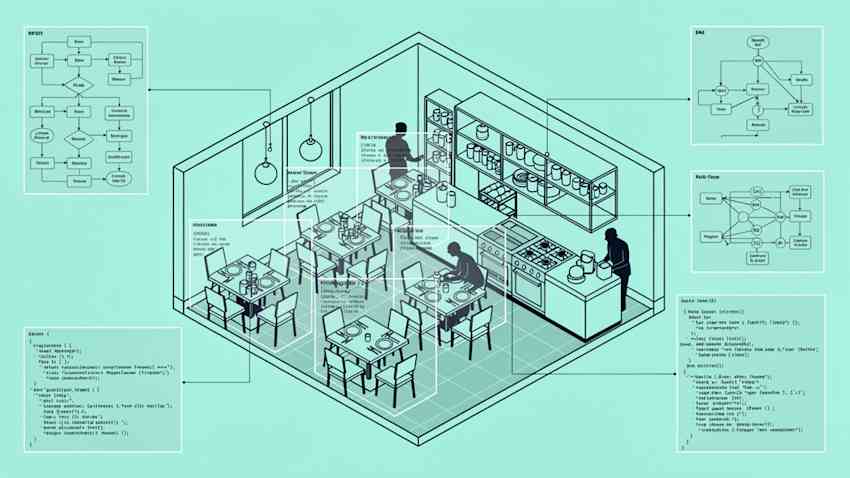
For the average restaurant owner, the challenge isn't just taking orders—it's managing the chaos of a thousand moving parts. Palona Vision seeks to act as an automated "best operations manager" that never sleeps. By utilizing existing in-store security cameras, the system analyzes operational signals like queue lengths, table turnover, and even kitchen cleanliness without requiring a single piece of new hardware.
Palona Workflow then takes that visual data and turns it into action. By correlating video signals with Point-of-Sale (POS) data and staffing levels, it automates multi-step processes like catering management and opening/closing checklists. As Shaz Khan, founder of Tono Pizzeria + Cheesesteaks, puts it: "It flags issues before they escalate and saves me hours every week."
4 Critical Lessons for AI Builders
Palona’s pivot from serving broad fashion and electronics brands to focusing exclusively on restaurants offers a blueprint for the next generation of AI startups. Here are the key takeaways for builders in this space:
1. Build for 'Shifting Sand'
With new models from OpenAI, Google, and Anthropic arriving almost weekly, Palona developed a patented orchestration layer. This architecture allows them to swap underlying models based on performance, fluency, and cost. The Lesson: Never let your product’s core value be a single-vendor dependency. By using a mix of proprietary and open-source models, Palona ensures they aren't locked into one provider's ecosystem.
2. Transition from Words to 'World Models'
While most AI struggles with abstract text, Palona Vision focuses on the physical reality of a kitchen. It can identify "cause and effect" in real-time—recognizing if a pizza is undercooked by its "pale beige" color or alerting a manager to an empty display case. The Lesson: In the real world, physics matters. AI that understands the physical environment provides far more value to traditional industries than a generic chatbot ever could.
3. Solve the Memory Gap with 'Muffin'
Standard vector-based memory often fails in complex environments. Palona built Muffin, a proprietary memory management system that handles four distinct layers:
- Structured Data: Facts like delivery addresses.
- Slow-changing Dimensions: Customer loyalty and favorite items.
- Transient Memories: Seasonal shifts (e.g., cold drinks in July).
- Regional Context: Time zones and language defaults.
4. Reliability through the GRACE Framework
In a restaurant, an AI hallucination can lead to a health safety risk or a ruined dinner rush. To prevent this, Palona employs the GRACE framework: Guardrails, Red Teaming, App Sec, Compliance, and Escalation. The Lesson: High-stakes environments require massive simulation. Palona simulated a million ways to order a pizza to ensure their system could handle the pressure without "breaking" brand trust.
The Bottom Line
Palona is betting that the future of enterprise AI lies in specialized "operating systems" rather than broad assistants. By narrowing their focus, they have gained access to proprietary training data and built deep integrations that generic AI cannot touch. As the AI industry matures, the survivors will likely be those who, like Palona, stop trying to be everything to everyone and instead master the unique complexities of a single, high-value domain.
For operators, the promise is simple. As Maria Zhang notes, if you have the food perfected, the AI will handle the rest: "We’ll tell you what to do."
Can You find Now