
TechVerda
Transforming Ideas Into Reality
- contact@techverda.com
- Innovation One, DIFC, Dubai

Blog Detail
MIT's 'Recursive' LLMs Shatter Token Limits, Solving the Context Rot Problem
MIT's 'Recursive' LLMs Shatter Token Limits, Solving the Context Rot Problem
Large Language Models (LLMs) have revolutionized how we interact with AI, but they've always been hampered by a significant limitation: their context window. Think of it like short-term memory – the model can only actively "remember" a certain amount of information at once. This has led to the frustrating phenomenon of "context rot," where earlier information gets lost or degraded in long conversations or when processing massive documents. But now, researchers at MIT's Computer Science and Artificial Intelligence Laboratory (CSAIL) have unveiled a groundbreaking new framework that could change everything.
Introducing Recursive Language Models (RLMs)
MIT's new approach, called Recursive Language Models (RLMs), reframes the challenge of long-context reasoning not as an issue of model capacity, but as a systems problem. Instead of trying to cram more text into the LLM's limited context window, RLMs treat the prompt as an external environment that the LLM can interact with programmatically. This means the LLM can inspect, decompose, and recursively call itself over specific snippets of text, allowing it to process an astonishing 10 million tokens without losing track of information.
The core idea is inspired by classical computing's "out-of-core" algorithms, which handle datasets larger than a computer's main memory by loading only necessary chunks. In the RLM framework:
- The entire prompt is loaded as a string variable within a Python coding environment.
- The LLM, acting as a programmer, writes code to interact with this variable. It can use commands like regular expressions to search for specific keywords or patterns.
- When a relevant snippet is identified, only that piece of text is loaded into the LLM's active context for analysis.
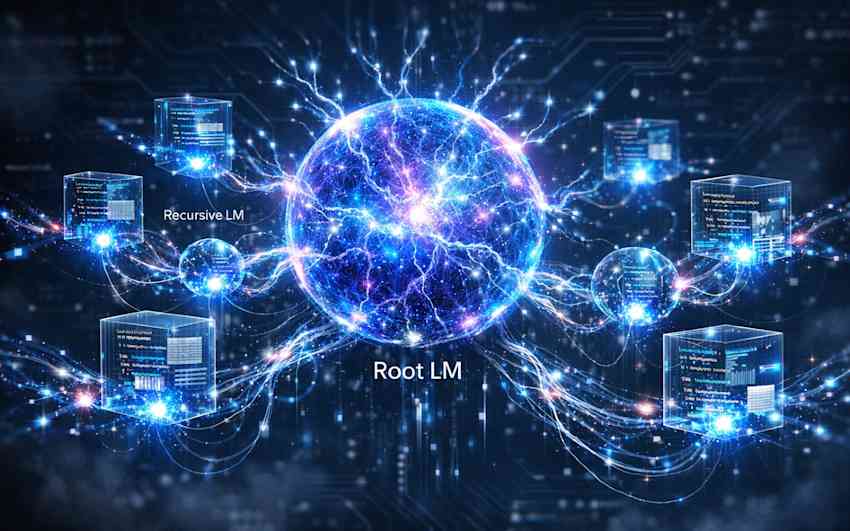
- This process can involve a "root language model" (like GPT-5) acting as an orchestrator and a faster, cheaper "recursive language model" as a worker, processing the isolated snippets.
The beauty of this approach is that it acts as a wrapper around existing LLMs, meaning it can be a drop-in replacement for current applications that directly call LLM APIs. This offers a practical pathway for enterprises to tackle long-horizon tasks that were previously impossible.
Why This Matters: Overcoming the LLM Bottleneck
Current LLMs, while powerful, struggle with tasks requiring the comprehension of vast amounts of data. Simply expanding context windows has proven inefficient due to the exponential increase in data samples needed and the inherent "context rot." Summarization techniques, a common workaround, fail when specific, non-contiguous details from early in the prompt are crucial. RLMs bypass these issues by enabling random access to information within the prompt.
The MIT team's research demonstrated remarkable results:
- On the BrowseComp-Plus benchmark (6-11 million tokens), base models scored 0%, while an RLM powered by GPT-5 achieved 91.33%.
- For complex reasoning on the OOLONG-Pairs benchmark, an RLM achieved an F1 score of 58%, compared to GPT-5's near-zero score of 0.04%.
- On code understanding tasks (CodeQA), RLMs more than doubled GPT-5's performance, jumping from 24% to 62%.
Furthermore, RLMs demonstrated consistent performance even with increasing task complexity, unlike base models which degrade rapidly. While there are concerns about potential "long-tailed" costs due to outlier runs, the framework often proved more cost-effective than summarization baselines.
The Future of Long-Context AI
RLMs represent a significant leap forward, making tasks like codebase analysis, in-depth legal document review, and complex multi-step reasoning far more feasible. While RLMs are not a replacement for standard retrieval methods like RAG, they can work in tandem to enhance their capabilities, particularly for applications like chatbots handling extensive chat histories.
The RLM framework is already available on GitHub, inviting developers to experiment. As this technology matures, we can expect LLMs to tackle increasingly complex and data-intensive challenges, unlocking new levels of AI-driven productivity and insight.
Can You find Now